

How to Read Sheet Music: A Practical Guide for Beginners
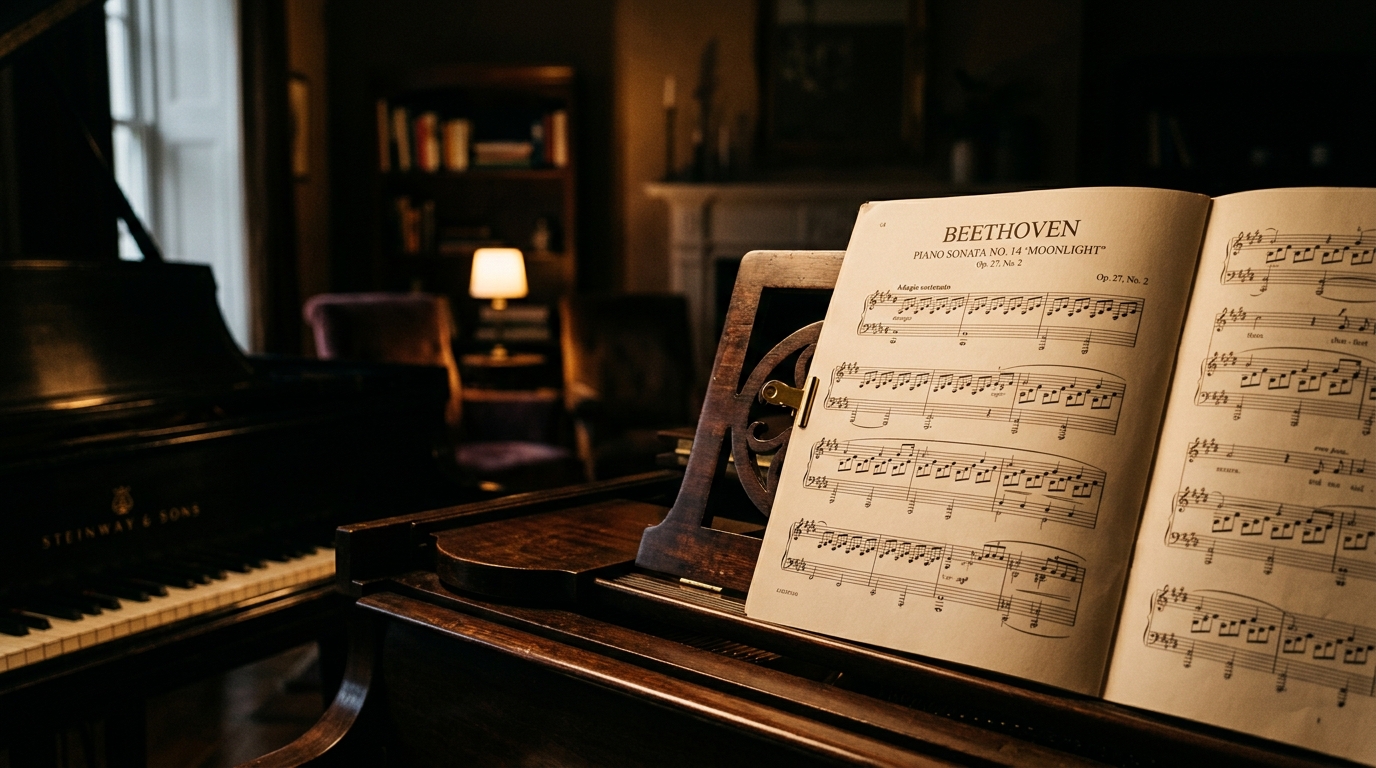
If you sit down at a piano or pick up a guitar and open a piece of sheet music, those dots and lines probably look like a foreign language. The truth is, figuring out how to read sheet music is much simpler than most people think. It isn't a complex math problem. It is just a map that tells your hands where to go and how long to stay there.
Most beginners get frustrated because they try to read entire songs right away. Instead of staring at a full page of notes and feeling overwhelmed, you just need to break the system down into its basic, individual parts.
Here is exactly how reading music for beginners works, step by step.
What You'll Need
Before we dive into the steps, you don't need much to get started:
- Your primary instrument (or just a free keyboard app on your phone to visualize the notes)
- A blank piece of staff paper or a notebook to draw out the lines
- A pencil (never use pen when writing music)
- Five minutes of patience
Step 1: Understand the Staff
Everything in sheet music is built on the staff. The staff is simply a set of five horizontal lines and the four spaces between them.
Think of the staff as a ladder. Every line and every space represents a different note. The higher up the ladder a note sits, the higher the pitch sounds. The lower down the ladder it sits, the lower the pitch.
When you place a note head (the oval part of the note) on a line, the line goes straight through the middle of the oval. When you place a note in a space, it sits snugly between two lines.
Sometimes, the notes need to go higher or lower than the five lines allow. When this happens, we use ledger lines. These are tiny, temporary lines drawn just for that specific note to extend the ladder up or down.
Step 2: Learn the Treble Clef and Bass Clef Notes
Because instruments cover such a wide range of high and low sounds, one staff isn't enough to fit everything clearly. We use symbols called "clefs" at the very beginning of the staff to tell us exactly which notes we are looking at. The two most common are the treble clef and the bass clef.
The Treble Clef
The treble clef looks like a fancy, swirling "G". In fact, its inner curl wraps around the line that represents the note G. It is used for higher-pitched instruments like the guitar, violin, flute, and the right hand of the piano.
To remember the notes on the lines (from bottom to top: E, G, B, D, F), most people use a simple phrase: Every Good Boy Does Fine. To remember the notes in the spaces (from bottom to top: F, A, C, E), just remember that they spell the word FACE.
The Bass Clef
The bass clef looks a bit like a backwards "C" with two dots. The two dots surround the line that represents the note F. It is used for lower-pitched instruments like the bass guitar, cello, tuba, and the left hand of the piano.
If you are playing piano, you need to remember the treble clef and bass clef notes simultaneously. Use different phrases for the bass clef. The lines from bottom to top are G, B, D, F, A: Good Boys Do Fine Always. The spaces from bottom to top are A, C, E, G: All Cows Eat Grass.
Try This Now
Grab a piece of paper: Draw five horizontal lines across the page. Draw a treble clef at the start of the lines. Now, using the acronyms above, draw a note head on the very bottom line (E). Draw another note head in the second space from the bottom (A). You have just written your first two notes.
Step 3: Understand Note Durations
Knowing which note to play is only half the battle. You also need to know how long to hold it. Sheet music uses the physical shape of the note to tell you its duration.
- Whole Note: Looks like an empty circle. You hold it for four beats.
- Half Note: Looks like an empty circle with a vertical stem attached. You hold it for two beats.
- Quarter Note: Looks like a solid black circle with a stem. You hold it for one beat.
If you are tapping your foot at a steady, even pace, a quarter note gets exactly one tap. A half note gets two taps. A whole note gets four continuous taps.
Just as there are symbols for playing notes, there are also symbols for silence. These are called rests. A quarter rest means you stay completely silent for one beat. A half rest means silence for two beats.
Common Mistakes When Learning How to Read Sheet Music
The absolute biggest trap beginners fall into is constantly writing the letter names underneath the notes on the sheet music.
While this feels helpful during your first practice session, it completely stunts your progress long-term. You end up reading your own handwriting instead of the actual music. If you want to read sheet music faster, force yourself to look at the physical position of the note on the staff. It will be slow and frustrating for the first week, but your brain will quickly start recognizing the visual positions instantly.
Another common mistake is ignoring the rhythm. Many learners spend ten seconds figuring out what note to play and then immediately play it, completely destroying the timing of the song. Always figure out the rhythm before you worry about the pitch.
Pro tip: If you are struggling with the rhythm of a difficult measure, put your instrument down. Clap your hands to the rhythm of the notes while counting the beats out loud. Do not pick your instrument back up until you can clap the entire rhythm perfectly.
FAQ: Common Questions About Reading Music
Do I have to read sheet music to be a good musician?
No. Many incredible, world-famous musicians play entirely by ear. However, reading music gives you a massive advantage. It allows you to learn new pieces instantly, communicate complex ideas with other musicians in a studio, and understand music theory much faster because you can actually see the physical structure of the music written down.
How long does it take to learn to read music?
You can learn the basic mechanics of how the staff works in an afternoon. However, reading it fluently (like reading a book) takes consistent practice over several months. Treat it exactly like learning to read English as a child. You start by sounding out individual letters, then words, and eventually, you read entire sentences without having to think about it.
Next Steps: Practice Sight Reading
The absolute best way to improve is to practice "sight reading" every single day.
Set a timer for five minutes. Find a piece of sheet music or use online note reading exercises that are significantly easier than what you normally play. Play through it slowly, from beginning to end, without stopping to correct your mistakes. The goal isn't to play it perfectly; the goal is to force your eyes to constantly look ahead to the next note.
Related Topics to Explore: