
Circle of Fifths Explained: What It Is and How to Use It
Most musicians first encounter the circle of fifths as a diagram in a textbook, stare at it for thirty seconds, decide it looks like something from a chemistry class, and move on. Which is a shame — because once it clicks, it’s probably the single most useful tool in all of music theory.
It’s not complicated. It just needs to be explained by someone who starts with what it does rather than what it is.
What Is the Circle of Fifths?
The circle of fifths is a diagram that arranges all 12 musical keys in a loop, organized by how closely related they are to each other. Keys that sit next to each other on the circle share almost all the same notes. Keys on opposite sides of the circle share almost none.
That’s the whole idea. Everything else — key signatures, chord progressions, modulation — flows from that one concept.
The name comes from how you move around the circle. Starting from C at the top and going clockwise, each key is a perfect fifth higher than the previous one: C → G → D → A → E → B → F# → C# → Ab → Eb → Bb → F → and back to C. Go counterclockwise and each step is a perfect fifth lower (or a perfect fourth higher, which is the same thing).
How to Read the Circle of Fifths
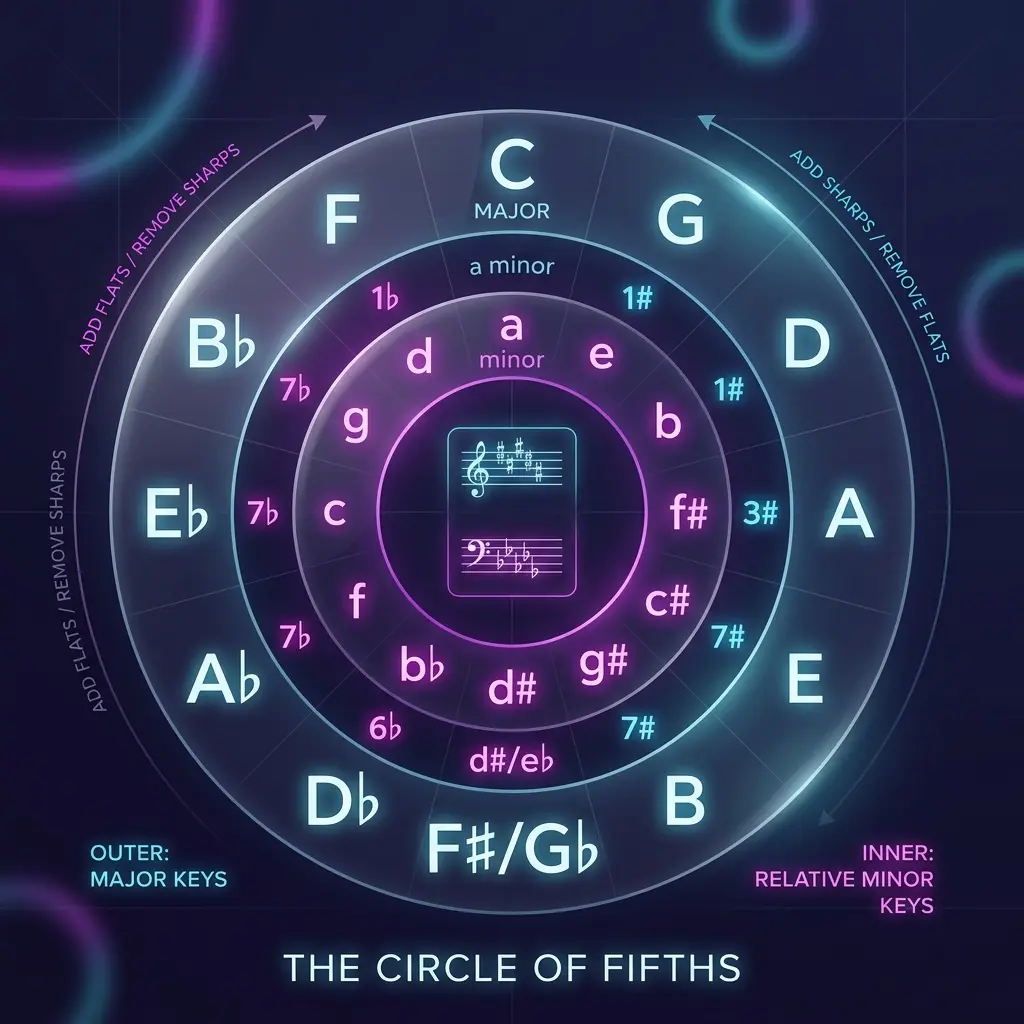
The standard diagram shows a few layers of information at once, which is part of why it feels overwhelming at first. Break it into pieces:
The outer ring shows the 12 major keys, arranged clockwise in order of increasing sharps (going right from C) and increasing flats (going left from C).
The inner ring shows the relative minor key for each major key — the minor key that shares the same notes. C major and A minor are relative keys, for example. They use the exact same seven notes, just starting from different places.
The key signatures (the number of sharps or flats) are usually shown between the rings or just outside the circle. C major has zero sharps or flats. G major has one sharp. D has two. Each step clockwise adds one sharp. Each step counterclockwise adds one flat.
Once you see that pattern, you’ll never need to memorize key signatures the hard way again. The circle tells you automatically.
Why Do Musicians Actually Use the Circle of Fifths?
Here’s where most theory explanations fall short — they explain the diagram but not the point of it. So let’s be direct.
Finding Chords That Fit Together
Keys that are neighbors on the circle share six out of seven notes. That means chords built from neighboring keys almost always sound good together. This is why the I, IV, and V chords — the three most fundamental chords in Western music — are right next to each other on the circle.
Play a song in C major. Your I chord is C. Your IV chord is F (one step counterclockwise). Your V chord is G (one step clockwise). They’re neighbors. That’s not a coincidence — it’s the geometry of the circle doing exactly what it’s designed to show you.
Understanding Why a Song “Feels” a Certain Way
When a song moves between keys that are close on the circle, the transition feels smooth and natural. When it jumps to the opposite side — what’s called a tritone or distant modulation — it creates tension or surprise. Film composers do this constantly to signal that something has shifted emotionally.
Next time a song catches you off guard with a key change, check where those two keys sit on the circle. Chances are they’re far apart.
Writing Chord Progressions Without Guessing
This is the practical one. If you’re writing a song in G major and you want to know which chords will naturally fit, the circle tells you immediately. G’s neighbors are D and C. A little further out are A and E minor. All of these will work. That’s not a coincidence — it’s the circle showing you the musical neighborhood you’re working in.
How to Actually Memorize the Circle of Fifths
Staring at the diagram until it sticks is the slow way. Here’s the faster way.
The clockwise sharps order can be memorized with a mnemonic. The keys going clockwise from C are: C, G, D, A, E, B, F#, C#. Many musicians use: “Cows Go Down And Eat Brown Fudge Carefully.” The number of sharps in each key matches its position: G has 1 sharp, D has 2, A has 3, and so on.
The counterclockwise flats order is just the reverse: C, F, Bb, Eb, Ab, Db, Gb. A common mnemonic: “Father Charles Goes Down And Ends Battle” — read it backward for flats: “Battle Ends And Down Goes Charles’ Father.”
Yes, it’s a bit silly. That’s why it works.
Try This Now
Draw the circle of fifths from memory. Don’t look at it — just try. Start by placing C at the top. Then add G to the right, D to the right of that, and keep going clockwise. Then go counterclockwise from C and add F, then Bb, then Eb. Fill in what you can. Check yourself, fix what’s wrong, and try again tomorrow. Most people can draw it reliably within a week of daily attempts. Once it’s in your head instead of on a page, you’ll actually use it.
What Is the Difference Between Major and Minor on the Circle?
Every major key has a relative minor that shares its notes exactly. On the circle, the relative minor sits inside the ring, directly beneath its major partner.
C major’s relative minor is A minor. G major’s is E minor. D major’s is B minor. The pattern repeats all the way around.
Why does this matter? Because when a song shifts from C major to A minor, it doesn’t feel like a dramatic key change — it feels like a mood change. Same notes, different emotional center of gravity. Songwriters use this all the time to move from a bright verse to a darker chorus without fully leaving the key.
Common Mistakes When Using the Circle of Fifths
Thinking it’s only for theory class. The circle isn’t an academic exercise. Professional songwriters, producers, and session musicians use it — or have internalized it so deeply they don’t need to look at it anymore. The goal isn’t to frame it on the wall. It’s to absorb it.
Confusing clockwise and counterclockwise. Clockwise = sharps = fifths going up. Counterclockwise = flats = fourths going up. It’s easy to get turned around until the pattern becomes automatic.
Ignoring the minor keys. A lot of beginners learn the outer ring and stop there. But pop, rock, and especially film music lives heavily in minor keys. Get comfortable with the inner ring too.
Thinking every chord progression must stay “inside” the circle. The circle shows you what’s naturally related — it doesn’t mean you can’t borrow from outside. Borrowed chords from a parallel key often create the most interesting moments in a song. The circle is a map, not a rulebook.
“The circle of fifths doesn’t tell you what to play. It tells you what’s available — and that’s the difference between an empty page and a starting point.”
FAQ
Do I need to memorize the circle of fifths to play guitar or piano?
You don’t need to, but players who understand it tend to learn songs faster, improvise more confidently, and make better decisions when writing. Think of it less as memorization and more as pattern recognition. Once you’ve played through enough songs, the relationships on the circle start to feel familiar before you’ve consciously memorized anything.
How does the circle of fifths relate to chord progressions?
Directly. The most common chord progressions in pop, rock, jazz, and classical music move between chords that are one or two steps apart on the circle. The I–IV–V progression, the ii–V–I in jazz, the vi–IV–I–V in pop — all of them sit in tight clusters on the circle. Once you see that, reading a chord chart or figuring out a song by ear becomes significantly easier.
Why does it go by fifths specifically?
A perfect fifth is the simplest harmonic relationship between two different notes — the two frequencies have a 3:2 ratio, which is why they sound so consonant together. Organizing keys by fifths means each neighboring key is as harmonically close as possible. It’s the most natural way to arrange the 12 keys into a continuous loop, and it’s why musicians have used this structure for centuries.
Recommended Next Steps
The circle of fifths is a foundation, not a destination. Once you can read it and use it, these are the natural places to go deeper:
- Learn your key signatures using the circle as your guide — not by flashcard
- Build basic chord progressions using I, IV, and V in a few different keys
- Explore relative minors by rewriting a major progression in its relative minor and hearing the shift
The circle of fifths is one of those rare things in music theory that actually gets more useful the longer you play. At first it helps you memorize key signatures. Later it helps you write songs. Eventually it becomes the lens through which you hear music automatically — and that’s when it stops feeling like theory and starts feeling like fluency.
Apply Your Knowledge
Want to see the circle in action? Use our Interactive Chord Finder to visualize how chords are built and find their scale formulas instantly.