
How to Play Guitar Solos for Beginners: Scales & Technique
Learning how to play guitar solos for beginners often feels like getting thrown on stage with no script. You have the pick in your hand, you know a handful of reliable open chords, but the moment the backing track starts up or it’s your turn to take a lead in a jam session, your mind just goes blank. Your fingers freeze. If you've ever tried to force a melody out of a scale shape and ended up sounding like you're practicing a sterile typing exercise rather than playing real music, you are certainly not alone.
Most people get this wrong the first time because they think soloing is about raw speed, flashy tricks, or knowing deeply complex music theory. It isn't. Some of the nastiest, most iconic solos in rock and blues history are built on just a handful of notes. Great lead playing comes down to owning a few simple shapes and using expressive techniques to make the guitar actually sing. It’s all about phrasing, rhythm, and playing in the pocket. Let's dump the academic jargon and dig into the gritty basics that will get you sounding musical on day one.
Gear Up: What You Need in the Woodshed
- An electric or acoustic guitar: While you can solo on an acoustic, an electric guitar with lighter strings is vastly easier for practicing techniques like bending and vibrato.
- A pick: A medium or heavy thickness plectrum (around 0.73mm to 1.14mm) provides the best control and attack.
- A backing track: Find one in the key of A minor. You can easily search YouTube or Spotify for "A minor blues backing track" or "A minor rock backing track."
- Patience: Your fingers are going to learn entirely new movements. You must be willing to sound a little clunky for the first few practice sessions.
Stop Noodling: The Pentatonic Box
Before you can tell a story, you need an alphabet. In the guitar world, your most reliable and versatile alphabet is the minor pentatonic scale. The pentatonic scale for solos is universally loved by beginners and professionals alike because it is incredibly forgiving. "Penta" means five, so this scale consists of just five notes that inherently sound bad-ass together. By stripping away the tense, awkward intervals found in standard seven-note scales, it makes it nearly impossible to play a completely "wrong" sounding note, provided you stick to the pattern and the key.
When guitarists talk about this scale, they usually refer to the "box" shape. This is a visual pattern of notes that sits across all six strings within a tight, four-fret span. It keeps your hand neatly anchored in one physical location on the neck.
Here is the most famous position for the A minor pentatonic scale, starting at the 5th fret on your thickest string (the low E string):
- Low E string (6th string): Play the 5th fret with your index finger, then the 8th fret with your pinky.
- A string (5th string): Play the 5th fret with your index finger, then the 7th fret with your ring finger.
- D string (4th string): Play the 5th fret with your index finger, then the 7th fret with your ring finger.
- G string (3rd string): Play the 5th fret with your index finger, then the 7th fret with your ring finger.
- B string (2nd string): Play the 5th fret with your index finger, then the 8th fret strictly with your pinky to avoid straining your wrist.
- High E string (1st string): Play the 5th fret with your index finger, then the 8th fret with your pinky.
Don't worry about memorizing the entire fretboard right now, and don't worry about the music theory behind why these notes work. Just memorize this one physical box. Play it ascending (from low strings to high strings), and play it descending (from high strings to low strings). Do this slowly with a metronome. The goal isn't speed yet; the goal is building the muscle memory so your fingers know where to go without your eyes having to stare at the neck.
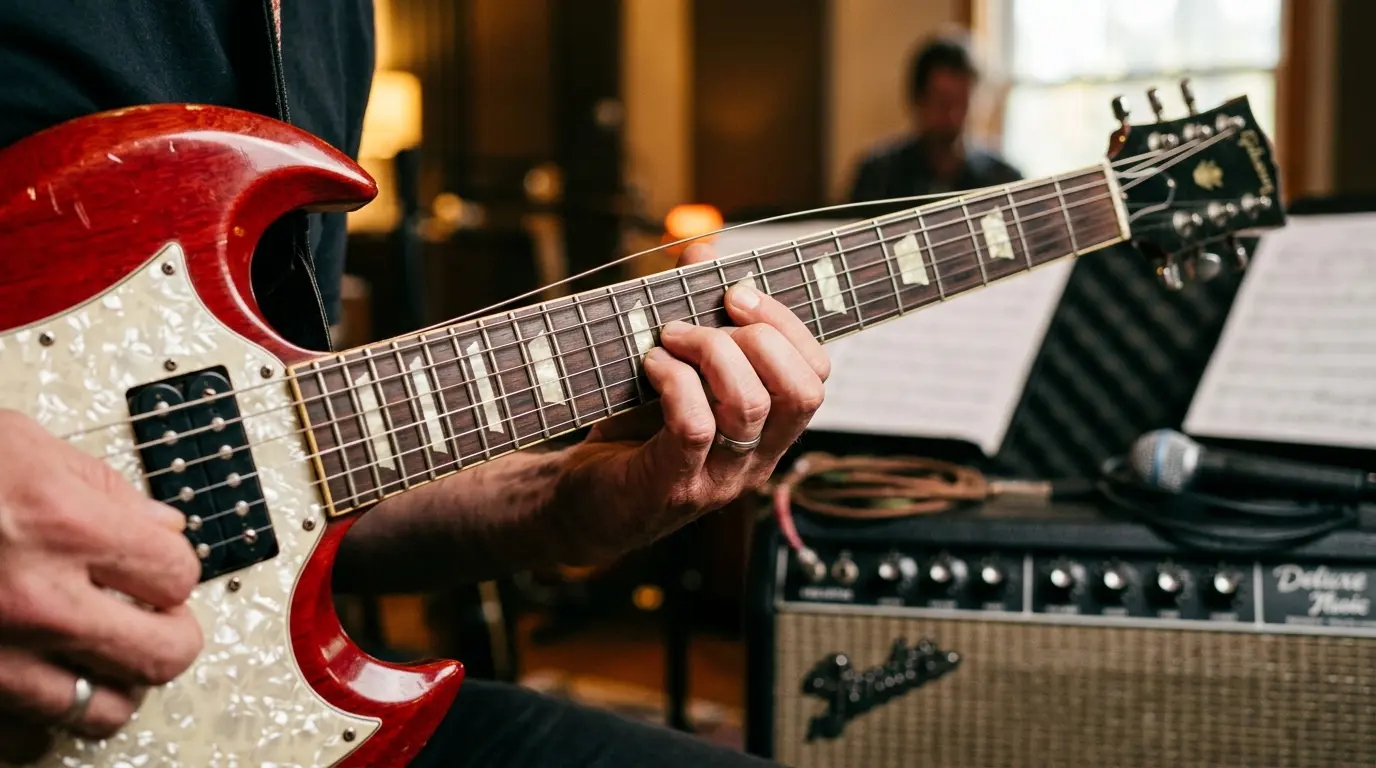
Making It Cry: The Art of the Bend
Now that you have the notes under your fingers, it's time to add some real character. If you just play the pentatonic scale rigidly up and down in time with a metronome, it sounds like an academic exercise. When you start manipulating those exact same notes, bending and shaping them, it transforms into music.
Bending is exactly what it sounds like: you fret a note, pick the string, and physically push or pull the string across the wood of the fretboard to raise its pitch. It mimics the natural slide of a human voice reaching for a high note.
Here's how to dig in without wrecking your hand:
- Anchor your hand: Never try to bend a string using only the brute strength of one isolated finger. If you want to bend the 7th fret on the G string with your ring finger, place your middle and index fingers on the 6th and 5th frets behind it. Use all three fingers together as a single, powerful unit to push the string.
- Turn the doorknob: The power for a bend doesn't actually come from squeezing your fingers. It comes from a twisting motion in your wrist and forearm—very similar to the motion of turning a stubborn doorknob or pouring a jug of water.
- Target the pitch: A sloppy, out-of-tune bend sounds terrible and amateurish. Play the normal, unbent note on the 9th fret of the G string. Listen to that pitch. Now, go back to the 7th fret, pick it, and bend the string up until it matches that 9th-fret pitch perfectly. This trains your ear and your hand simultaneously.
Pro tip: If your fingertips are burning and the string keeps slipping under your fingernail, you are likely pressing down too hard vertically into the fretboard. Relax your grip slightly. Try to push the string sideways across the surface of the frets rather than just burying it straight down into the metal.
Vibrato: Making One Note Matter
Vibrato is the subtle, rhythmic fluctuation of pitch that gives a note a vocal, singing quality. Without vibrato, a long, held note on an electric guitar sounds flat, sterile, and lifeless. With it, the note sustains significantly longer, carries deep emotion, and sounds professional. Think of B.B. King; he could play just one single note, but his legendary vibrato made it sound like a person weeping.

To practice the mechanics of good vibrato:
- Play a note—let's stick to the 7th fret on the G string.
- After you pick the string, use that same "doorknob turning" motion from your wrist to rapidly bend and release the string just a tiny, microscopic fraction of an inch.
- Keep the rhythm incredibly even. Don't make it a frantic, nervous, out-of-control shake. Think of the slow, deliberate, pulsing waver of an opera singer's voice.
- Start slow. Pick the note, bend slightly up, return to center, bend slightly down, return to center. Do it to a tempo. Speed it up only as you gain control over the width and rhythm of the fluctuation.
Smooth Operators: Legato Playing
If you aggressively pick every single note, your solos will sound blocky and robotic. Legato (slides, hammer-ons, and pull-offs) lets you glide between notes with zero pick attack, giving your playing that slick, fluid polish.
- Slides: Pick a note, keep your finger firmly pressed down on the string, and simply slide your finger up or down the string to a new fret. This physically connects the two notes with a continuous, seamless glide of sound. It's great for shifting between different pentatonic box shapes.
- Hammer-ons: Pick a starting note, then quickly and forcefully slam another finger down onto a higher fret on that exact same string. The physical impact of your second finger hitting the wood creates the new note without your picking hand doing any extra work.
- Pull-offs: This is the reverse of a hammer-on. Fret two notes on the same string simultaneously (for example, your index on the 5th fret and ring on the 7th). Pick the string so the 7th fret sounds, then pull your ring finger off the string with a slight downward plucking motion to sound the 5th fret note.
Master these and your solos will stop sounding like a beginner's practice session. That's the line between intermediate and just starting out.
How to Actually Improvise (Without Panicking)
Once you have the alphabet (the scale) and the inflection (the techniques), how do you actually figure out how to improvise a guitar solo?
The biggest trap is blowing through all your notes at 100 miles per hour. Soloing is a conversation. If you talk continuously without taking a breath, everyone tunes you out. Your guitar playing works the very same way.
Here’s a bulletproof way to build a solo:
- Start with a motif: A motif is just a short musical idea. Pick just three or four notes from your minor pentatonic box. Play a simple rhythm with them.
- Leave space: Play your short phrase, then stop playing completely. Let the backing track carry the rhythm and groove for a full measure. Silence is a musical note too.
- Repeat and vary: Play that exact same three-note phrase again. Then, on the third time, change the ending slightly—maybe add a bend to the final note, or slide up to a higher fret. This creates a theme, which gives your solo a sense of structure.
- Hum what you play: If you can't hum or sing the solo you are playing, it's probably too complicated and chaotic. Singing along with your fingers forces your brain to create melodic, memorable lines rather than just running scales up and down like a robot.
Try This Now
Put on an A minor blues backing track right now. Limit yourself strictly to only the B and high E strings in your pentatonic box (frets 5 and 8). Improvise a solo for two full minutes using only those four notes.
Do not allow yourself to touch the other four strings. Focus entirely on rhythm, bending the 8th fret on the B string, holding notes with vibrato, and leaving massive, dramatic gaps of empty space between your phrases. You will be shocked at how musical you can sound with just four notes when you are forced to focus on phrasing.
Common Clams & How to Avoid Them
These are the traps almost every beginner walks straight into. Know them, own them:
- Never resolving the melody: The minor pentatonic scale sounds great over chords, but it has a specific "home" note, called the root. In the key of A minor, the root note is A. If you constantly end your phrases on random, floating notes in the scale, your solo will sound wandering, aimless, and unfinished. Always try to resolve your big ideas back to the root note (like the 7th fret on the D string or the 5th fret on the high E string in your box shape). It gives the listener a sense of musical closure.
- Ignoring the rhythm: A technically "wrong" note played with incredible rhythm and confidence sounds like intentional jazz. A perfectly "right" note from the scale played completely out of time sounds like a glaring mistake. Lock in with the drums and bass of the backing track. Tap your foot. Let the groove dictate your playing.
- Overusing effects: Drenching your guitar signal in massive amounts of delay, reverb, and heavy distortion might temporarily mask your sloppy mistakes, but it also completely ruins your dynamic control. Practice your solos with a clean or only slightly crunchy tone so you can critically hear every single nuance of your bends, your vibrato, and your pick attack.
FAQs About Beginner Lead Guitar
What's the exact difference between a riff and a lick?
A riff is a repeating, foundational musical idea that forms the structural backbone of a song (think of the iconic opening to Smoke on the Water or Seven Nation Army). A lick is a short, isolated, single-note phrase used specifically within a solo. Great solos are essentially a string of well-practiced licks — think the intro to "Comfortably Numb" or the opening of "Layla." Short ideas, stitched together.
Do I need to learn music theory to play solos?
No, not immediately. Many legendary guitarists, especially in the rock and blues genres, rely primarily on their ear, their intuition, and visual scale shapes rather than deep academic theory. However, understanding basic concepts—like the names of the notes on the fretboard, what key a song is in, and how chords are constructed—will drastically speed up your progress and save you years of trial and error.
How fast should I be picking?
Speed is a byproduct of accuracy. Never pick faster than your fretting hand can cleanly move. Start with a click track at a crawling pace, and only bump the tempo when you can play the lick ten times perfectly without a single clam.
Next Steps
Now that you have the tools, the best way to level up is to steal from the heavyweights. Start learning solos note-for-note. Listen to how David Gilmour uses massive, cinematic bends in Wish You Were Here, or how B.B. King wrings incredible amounts of emotion out of just one or two strategically placed notes.
Rip off their vibrato. Steal their phrasing. Eventually, as you put all these stolen pieces into the blender, they’ll mutate and become your own unique voice.
References
[1] How to Write Guitar Solos, Guitar World https://www.guitarworld.com/lessons/how-to-write-guitar-solos
[2] Vibrato Technique Lesson, JustinGuitar (YouTube) https://www.youtube.com/watch?v=i9yDenSMpJk
[3] Pentatonic Scale, Wikipedia https://en.wikipedia.org/wiki/Pentatonic_scale
[4] String Bending, Wikipedia https://en.wikipedia.org/wiki/String_bending