
How to Harmonize a Melody: A Practical Guide
That moment when two voices lock together and the room suddenly feels bigger — that's harmony doing its job. It's not magic. It's interval math you can learn in an afternoon and practice until it becomes instinct.
Whether you want to how to harmonize a melody by ear as a singer or you're building a second guitar or keyboard line on top of a lead melody, the process is the same at its core: you're choosing a companion pitch that sounds consonant against each note of the main line. This guide breaks it down step by step, from the theory you actually need to the drills that make it stick.

What Harmony Actually Is (And What It Isn't)
Harmony isn't a random second note that sounds pretty. It's a pitch relationship — specifically, the vertical relationship between two notes sounding at the same time or in close succession.
When you harmonize a melody, you're not making up a new, independent tune. You're building a line that tracks the original melody at a consistent interval — usually a third or a sixth above or below — while staying inside the same key. The melody leads; the harmony follows its shape.
The key phrase there is inside the same key. That's the rule that separates deliberate harmony from accidental dissonance. Every note you sing or play on your harmony line has to be a scale degree from the song's key — not just any note that feels higher.
The Two Intervals That Do Most of the Work
You could write an entire textbook on harmony intervals, but for practical harmonizing — vocal harmony for beginners and seasoned players alike — two intervals cover probably 85% of what you'll encounter in pop, country, folk, gospel, and rock:
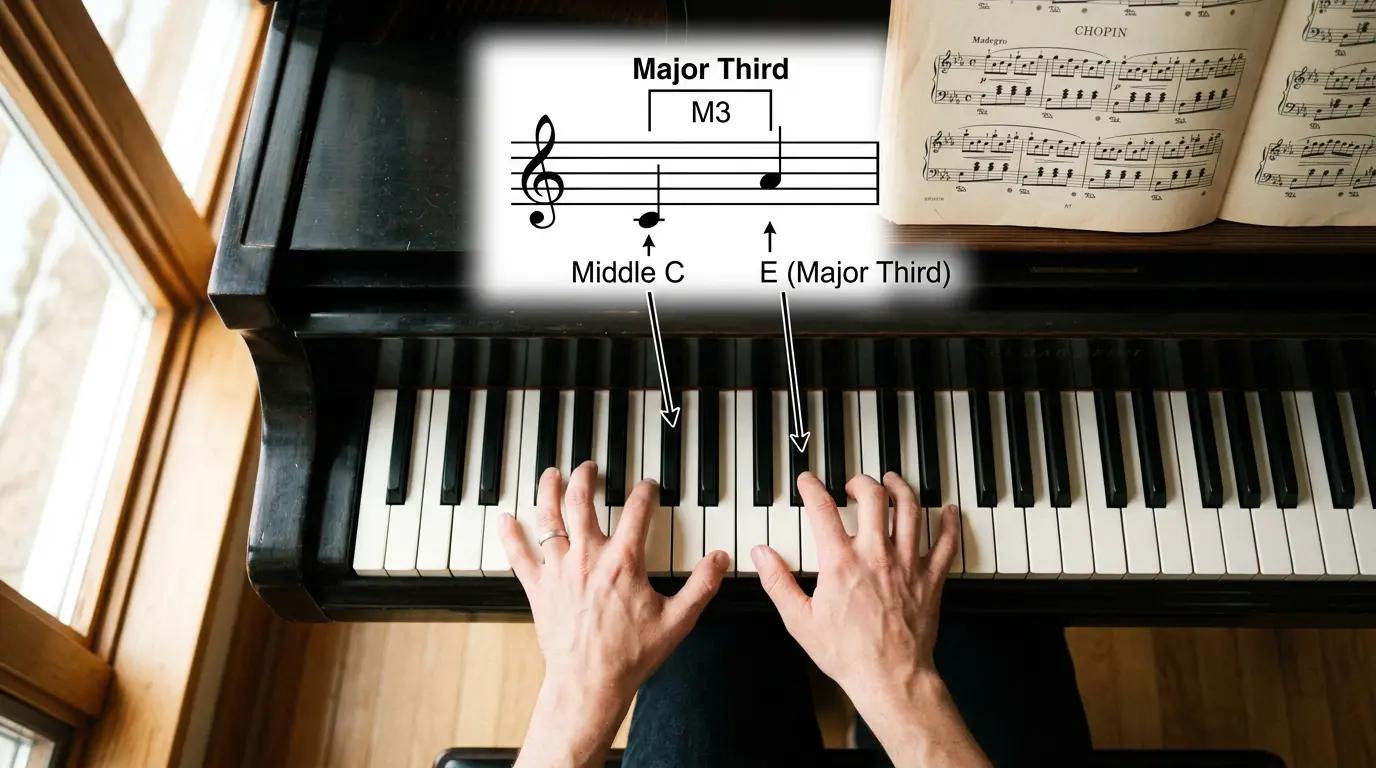
Thirds: Count up two scale steps from the melody note. If the melody lands on C in the key of C major, your harmony note is E. If it lands on D, your harmony lands on F. That's a third. Thirds are the warmest, most instinctively pleasing interval — you hear them in everything from Eagles harmonies to bluegrass fiddling.
Sixths: Count up five scale steps, or equivalently, count down two. In the key of C major, a sixth above C is A. A sixth above D is B. Sixths are a bit airier and more open than thirds — they're the interval you hear in the "ah" sections of a lot of classic pop ballads.
You might also use fifths for a more hollow, open sound (common in modal folk and Gregorian-influenced music), and fourths occasionally, but start with thirds. They'll get you through most situations.
Step-by-Step: How to Harmonize a Melody
Step 1 — Know the Key
Before you touch a harmony note, lock in the key of the song. If you don't know it, use your instrument to find the root chord — the chord that feels like home. Everything rests on this step. If you sing harmony in the wrong key by even one accidental, it'll clash.
If key identification is new territory for you, read our guide on how to find the key of a song before continuing.
Step 2 — Write Out (or Visualize) the Scale
Once you know the key, lay out its scale in your head or on paper. In C major: C D E F G A B C. In G major: G A B C D E F# G. This scale is your ingredient list. Every note in your harmony line gets pulled from it — nothing else.
If you're on guitar, run the scale pattern. If you're at the piano, play it up from the root. If you're a singer, use a reference instrument or app to hear each step. Do not skip this — harmonizing without knowing the scale is guessing, and guessing gets you in trouble fast.
Step 3 — Map Harmony Notes Diatonically
Now go through the melody note by note and count up a third (two scale steps) from each one using only notes from the scale. This is called diatonic harmony, and it's the backbone of the technique.
Here's how it looks in C major for a melody fragment moving C → D → E → F:
| Melody Note | Count Up Two Scale Steps | Harmony Note (3rd) |
|---|---|---|
| C | C → D → E | E |
| D | D → E → F | F |
| E | E → F → G | G |
| F | F → G → A | A |
Notice something: the interval isn't always exactly the same number of semitones. C to E is a major third (4 semitones), but D to F is a minor third (3 semitones). That variation is exactly what keeps the harmony line sounding inside the key instead of robotic. The key takes care of the tuning automatically — you just count scale steps, not semitones.
Step 4 — Sing or Play the Harmony Line in Isolation First
This is the step most people skip, and it's why their harmonies wander. Before you try to perform both the melody and the harmony at once, practice the harmony line alone until you can sing or play it cleanly from memory.
The harmony line should make sense as a line on its own. It won't be as memorable as the melody, but it should have a natural shape. If you can't find it without the melody propping you up, you haven't learned it yet.
Step 5 — Layer It with the Melody
Once the harmony line is solid on its own, bring it in against the melody. If you're working with another singer or player, have the melody player hold steady while you introduce the harmony. If you're doing it yourself (overdubbing, or doubling on your instrument), record the melody first and then add the harmony pass.
Listen critically. Does it sound like one coherent sound with richness, or does it sound like two separate things fighting each other? Good harmony disappears into the blend — you feel the fullness before you consciously hear the second voice.
Step 6 — Adjust Where the Harmony Clashes
Some melody notes might produce awkward intervals with a strict diatonic third. A few situations to watch for:
- If the melody leaps by a fourth or fifth, your harmony might need to move to a sixth temporarily to avoid parallel fifths (which sound hollow and strange in most modern contexts).
- At phrase endings, especially on the root note of the key, you might want to land on the fifth above for a stronger resolution — rather than a third.
- If the song uses a borrowed chord (a chord not in the key), the harmony note may need to follow the chord tone rather than the scale step.
These adjustments come with ear training and practice. For now, start strict with diatonic thirds, then use your ears to smooth out the rough spots.
How to Sing Harmony Without Losing the Melody
This is the hard part for singers. Your brain keeps pulling you back to the melody because you know it better. Three techniques help:
Hear the melody as a floor, not a ceiling. Your job is to float above it (or below it). Don't track it — lock your part to it the way two train cars couple together: connected, but each moving independently.
Learn it instrumentally first. If you can play the harmony line on piano or guitar, play it until it's in your ear as a separate, complete thing. Then switch to singing it. Your ear now has a template that isn't the melody.
Practice with a recording. Play the original song at reduced volume and sing your harmony over it. If you start sliding toward the melody, stop, isolate your note, and re-enter. This is woodshedding at its most productive.
Pro tip: Record yourself singing the harmony alone, then play it back against the original melody track. You'll hear pitch drift and tracking problems immediately — things your brain masks when you're in the act of singing.
Harmonizing Below the Melody: A Different Feel
Everything above assumes you're harmonizing above the melody. But you can also harmonize below it, and it changes the character significantly.
A third below the melody note gives you the same warmth as a third above, but the harmony sits under the melody rather than crowning it — the melody stays on top, and the lower voice fills out the sound from underneath. You hear this a lot in two-part gospel and country duets where a baritone or alto sits below the lead.
To find a diatonic third below: instead of counting up two scale steps, count down two. In C major, a third below C is A. A third below G is E.
Sixths below are equivalent to thirds above (the same two notes, just which one is on top has flipped), so you'll notice the math loops back around once you're comfortable with inversions.
Using Chord Tones to Harmonize More Precisely
Once you're comfortable with diatonic thirds and sixths, you can refine your harmony choices by thinking in chord tones rather than just scale steps. This is how more advanced harmony parts are crafted — and it's what separates a smooth background vocal from one that sounds slightly "off" even when it's technically in key.
The idea: instead of blindly counting up a third, ask what chord is playing under this melody note. Then choose your harmony note from the notes of that chord.
If the chord is C major (C, E, G) and the melody is on E, harmonizing with a G (a third above) is strong — both G and E are chord tones, and the harmony reinforces the chord. But if the melody is on B and the chord is G major (G, B, D), a third above gives you D — also a chord tone.
This approach naturally handles most of the awkward moments that strict diatonic thirds produce at chord changes. Understanding chord inversions and which notes belong to each chord in a key will help you make these choices faster.
Try This Now
Pick a simple melody you know well — "Twinkle Twinkle Little Star" works perfectly. The melody goes: C C G G A A G — F F E E D D C.
- Sing or play the melody once through.
- Now, using the C major scale (C D E F G A B C), count up two scale steps from each note and write down the harmony:
- C → E, G → B, A → C, G → B, F → A, E → G, D → F, C → E
- Sing or play just the harmony line until you can do it without looking at your notes.
- Finally, play a recording of the original melody and sing the harmony on top.
If you nail step 4 without collapsing back into the melody, you've successfully harmonized a song. That's the whole skill — you're now repeating it at higher complexity.
Common Mistakes That Kill a Harmony
Singing the melody a step higher. This is the most common error. It sounds like harmony but it isn't — you're just slightly off-key from the main voice. The fix is internalizing the scale step difference, not a vague "higher."
Ignoring the key when the melody jumps. Big melodic leaps often require you to reconsider your harmony interval. Don't assume a third above every note — listen to whether it clashes, and drop to a sixth or unison if it does.
Forcing harmony onto notes that don't need it. Passing notes (quick notes that move between two target notes) often sound cluttered when harmonized. Try harmonizing only the sustained, structural notes of the melody and resting on the passing tones.
Waiting until recording to check. Practice harmony against the melody track constantly, not just when it's time to lay it down. Your ear needs reps — the same way your fingers need reps on a new chord shape.
FAQ
Do I Have to Know Music Theory to Harmonize a Melody?
Not formally, but you do need to be able to identify the key and count scale steps. That's a pretty small subset of theory, and this guide covers the parts you need. Being able to play or reference the scale on an instrument helps enormously — even if you're primarily a vocalist, having a piano or guitar nearby to find notes speeds up the learning process considerably.
What's the Difference Between Harmony and a Countermelody?
A harmony follows the melody at a consistent interval — it's dependent on the melody and moves with it. A countermelody is a fully independent melodic line that weaves around and against the main melody, sometimes moving in opposite directions, sometimes converging. Harmonies blend; countermelodies contrast. Most vocal harmony parts are true harmonies, while many instrumental arrangements use countermelodies.
Can You Harmonize a Melody in a Minor Key?
Absolutely — and the process is identical. Map out the natural minor scale (e.g., A B C D E F G A for A natural minor), then count up diatonic thirds from each melody note using only those scale tones. The thirds will alternate between major and minor just as they do in a major key, and the resulting harmony will naturally have that minor key character. For a deeper look at how minor keys work in practice, our guide on major vs. minor chords is a useful read alongside this one.
Harmonizing is one of those skills where the gap between "I know how this works" and "I can actually do it in real time" is bridged entirely by slow, deliberate reps. So here's your next move: take one song you're already working on, map out a diatonic third harmony for the chorus, and woodshed that harmony line in isolation until it's memorized. Then layer it in. That one exercise, done properly on a real song you care about, will teach you more than a month of reading about intervals.
For the next step after harmony, ear training for intervals will sharpen your ability to hear and target those thirds and sixths instinctively — which is ultimately how the best harmony singers do it, without counting scale steps at all.
References
[1] Harmony and Voice Leading, Music Theory Online https://www.musictheoryonline.com
[2] Intervals and Harmony, musictheory.net https://www.musictheory.net/lessons/30
[3] Diatonic Harmony Explained, Berklee Online https://online.berklee.edu/takenote/diatonic-harmony
[4] Vocal Harmony Techniques, National Association of Teachers of Singing https://www.nats.org