
Major vs Minor Chords: The Core Difference Explained
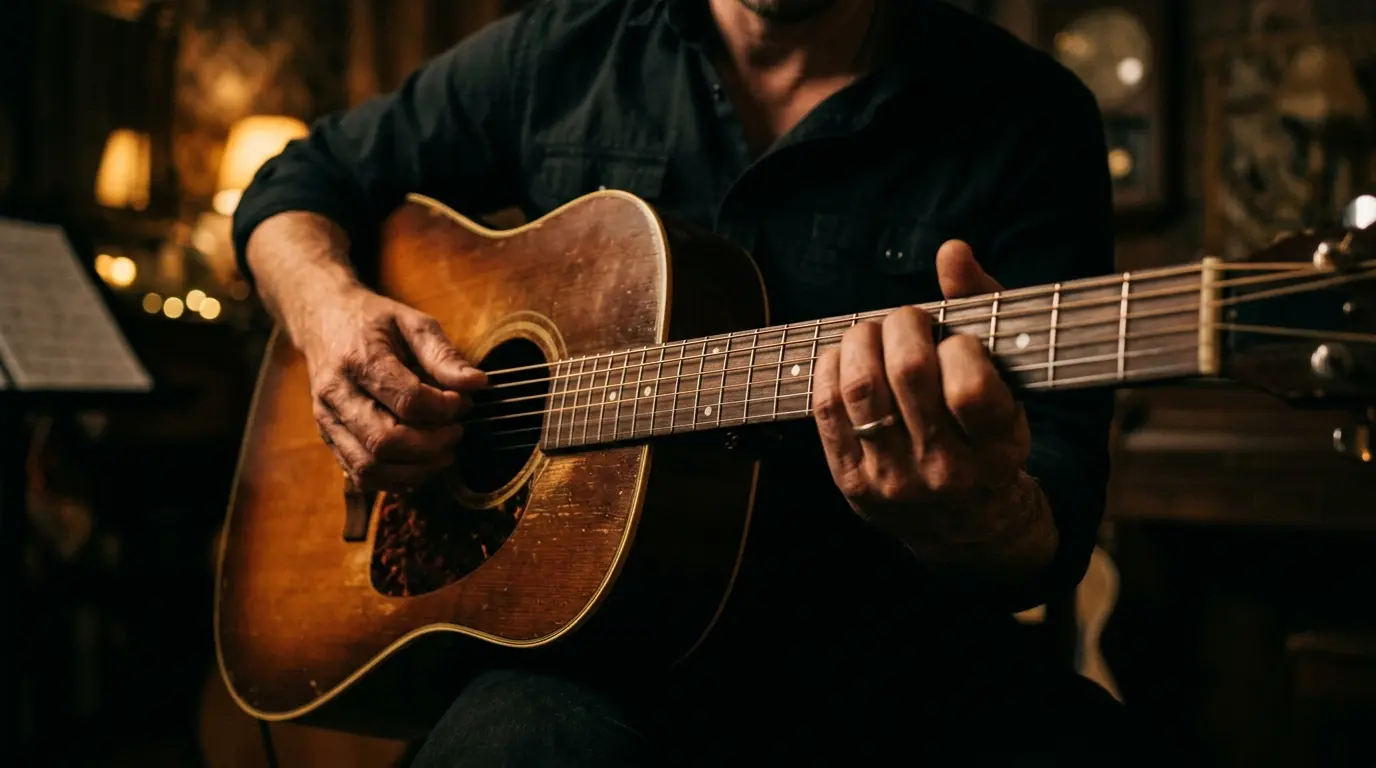
If you strum a C chord and it sounds bright and stable, then switch to an A minor and suddenly feel a sense of tension or melancholy, you've just experienced the difference between major vs minor chords. That shift in emotion isn't magic. It comes down to a single, easily identifiable note that changes the entire mood of the chord.
Most beginners think they need to memorize hundreds of separate chord shapes to understand how harmony works. The truth is much simpler. Once you understand the physical distance between notes, you can build or alter any chord on command.
Here is exactly how these chords work, why they sound the way they do, and how you can start using them on your instrument today.
Major vs Minor Chords: The Core Difference
Every basic chord in western music is made of three notes. We call this three-note grouping a triad. These three notes are named the root, the third, and the fifth.
The root gives the chord its letter name. If you are playing a G chord, the root note is G. The fifth sits on top and provides stability and power to the chord. Learn more with this triad construction lesson.
The real difference between major and minor happens entirely in the middle note—the third.
In a major chord, the distance from the root up to the middle note is exactly four half-steps. On a piano, a half-step is just moving to the very next key, counting the black ones. On a guitar, a half-step is one fret. This four-half-step distance is called a major third interval. It sounds open, bright, and resolved.
In a minor chord, we take that middle note and lower it by just one half-step. The distance from the root is now three half-steps instead of four. This creates a minor third interval. That slight compression of space adds tension and a completely different emotional quality to the sound.
How to Build a Minor Chord From a Major Chord
You don't need to learn a minor chord from scratch if you already know its major counterpart. You just need to locate the third note and lower it by a half-step. This means moving one fret lower on a guitar, or one key to the left on a piano.
Let's look at a C chord. The notes are C (the root), E (the major third), and G (the fifth). If you want to make a C minor chord, you find the E, and lower it one half-step to Eb (E flat). The notes become C, Eb, and G.
The root stays exactly the same. The fifth stays exactly the same. Only that middle note drops down.
Let's look at another common example: E major. The notes are E, G#, and B. To make it E minor, we lower the G# by one half-step. The note becomes a natural G. The chord is now E, G, and B.
Try This Now
If you play piano: Play a standard C major chord with your right hand (C-E-G). Now, keep your thumb on C and your pinky on G. Take your middle finger off the white E key and move it down to the black Eb key. Alternate between the two chords. Listen to how drastically the mood shifts just by moving one finger.
If you play guitar: Play an open A major chord. Find the note you are pressing on the B string (the second string from the bottom). That is your third note, a C#. It's sitting on the second fret. Now, play an open A minor chord. Notice how that single finger moves down from the second fret to the first fret, changing the note to a natural C. You've just lowered the third by a half-step.
Why Do We Call Them Sad Chords and Happy Chords?
It is incredibly common to hear major chords described as "happy chords" and minor chords described as "sad chords." While this is a helpful shortcut for absolute beginners, it isn't entirely accurate.
A minor chord isn't inherently sad on its own. The feeling it produces depends entirely on the context of the song, the tempo, and the rhythm you play it with. Many high-energy, aggressive rock songs or driving dance tracks rely heavily on minor chords to sound powerful and urgent. Conversely, a slow acoustic ballad built entirely on major chords can sound nostalgic, bittersweet, and heartbreaking.
Instead of thinking in terms of happy and sad, try thinking in terms of tension and resolution. Major chords feel settled and stable. Minor chords feel unresolved, adding emotional weight and tension that usually wants to move somewhere else.
Understanding Major and Minor Scales
Chords don't exist in a vacuum. They are usually built from scales. The relationship between major and minor scales works exactly the same way as the chords themselves.
A major scale has a bright, familiar sound—think of singing "Do-Re-Mi." A minor scale takes that same structure but lowers the third, sixth, and seventh notes by a half-step.
When you build chords out of a major scale, you naturally get a mix of both major and minor chords. For example, the scale of C major contains the notes C, D, E, F, G, A, and B. If you build a chord starting on C, you get C major. If you build a chord starting on A using those same exact notes, you naturally create an A minor chord. This is why A minor is called the "relative minor" of C major.
Recognizing Major vs Minor in Popular Music
Theory is much easier to absorb when you can attach it to songs you already know. Let's look at how major and minor chords are used in the real world to dictate the feel of a piece of music.
When a song is built primarily around major chords, it often feels anthemic, triumphant, or pop-oriented. Think of a classic song like "Let It Be" by The Beatles. The progression heavily leans on C major, G major, and F major. Even though there is an A minor chord in the progression, the overwhelming feeling is one of resolution and comfort.
On the flip side, consider a song like "House of the Rising Sun" by The Animals. It famously opens with a sweeping, arpeggiated A minor chord. That single minor chord immediately sets a dark, brooding atmosphere before the vocalist even sings a word.
This is why songwriters carefully choose their chords. If you write a lyric about a devastating breakup but place it over a bouncy, upbeat C major chord progression, the listener will feel a disconnect between the words and the music. But if you take that same lyric and place it over a D minor progression, the music suddenly supports and amplifies the emotion of the lyric.
Try This Now: The Song Swap
Take a simple, three-chord song you already know how to play. "Knockin' on Heaven's Door" is a great example (G major - D major - C major).
Try playing the exact same rhythm and the exact same melody, but swap every major chord for its minor equivalent (G minor - D minor - C minor). The song will become instantly unrecognizable. It will feel eerie, tense, and completely wrong. This is the power of the third note at work. By changing just one note in each chord, you completely rewrite the emotional DNA of the song.
How to Play Minor Chords Without Memorizing Everything
The biggest mistake beginners make is treating every single chord like an isolated island. If you want to figure out how to play minor chords across your entire instrument, stop relying purely on chord charts and start looking for the third.
Pro tip: If you are playing an E-shape barre chord on guitar, look at your middle finger. In that common shape, your middle finger is playing the major third. Lifting your middle finger off the string lowers that note by one half-step because the barre finger behind it takes over the fret. You've instantly turned a major chord into a minor chord with zero extra effort.
Once you see the pattern, you only need to learn half as many chords. You learn the major shape, locate the third, and drop it.
FAQ: Common Questions About Major and Minor
Can you play minor chords in a major key?
Yes. In fact, every major key naturally contains three minor chords. In the key of C major, the chords built on D, E, and A will always be minor (D minor, E minor, and A minor). This mixture is what gives chord progressions their emotional pull and contrast. Playing only major chords in a major key would sound flat and robotic.
What happens if I lower the fifth note instead of the third?
If you leave the major third alone and lower the fifth note by a half step, you create a diminished or augmented sound depending on the exact intervals, but you do not create a minor chord. The third is the sole decider of major vs minor.
Are there chords that are neither major nor minor?
Yes. Power chords (common in rock and metal) contain only the root and the fifth. Because they completely omit the third, they are technically neither major nor minor. They take on the quality of whatever scale is being played underneath them.
Next Steps: Train Your Ear to Hear the Difference
Knowing the theory is only half the battle. Now you need to recognize the difference when you hear it.
Sit down at your instrument, close your eyes, and play a major chord, then immediately play its minor equivalent. Do this for five different root notes. Focus entirely on the sensation of that middle note moving down a half-step. Once you can consistently hear the tension introduced by that minor third, you will start recognizing it instantly in the songs you listen to every day.
Related Topics to Explore: