
How to Read Ukulele Tabs: A Step-by-Step Guide for Beginners
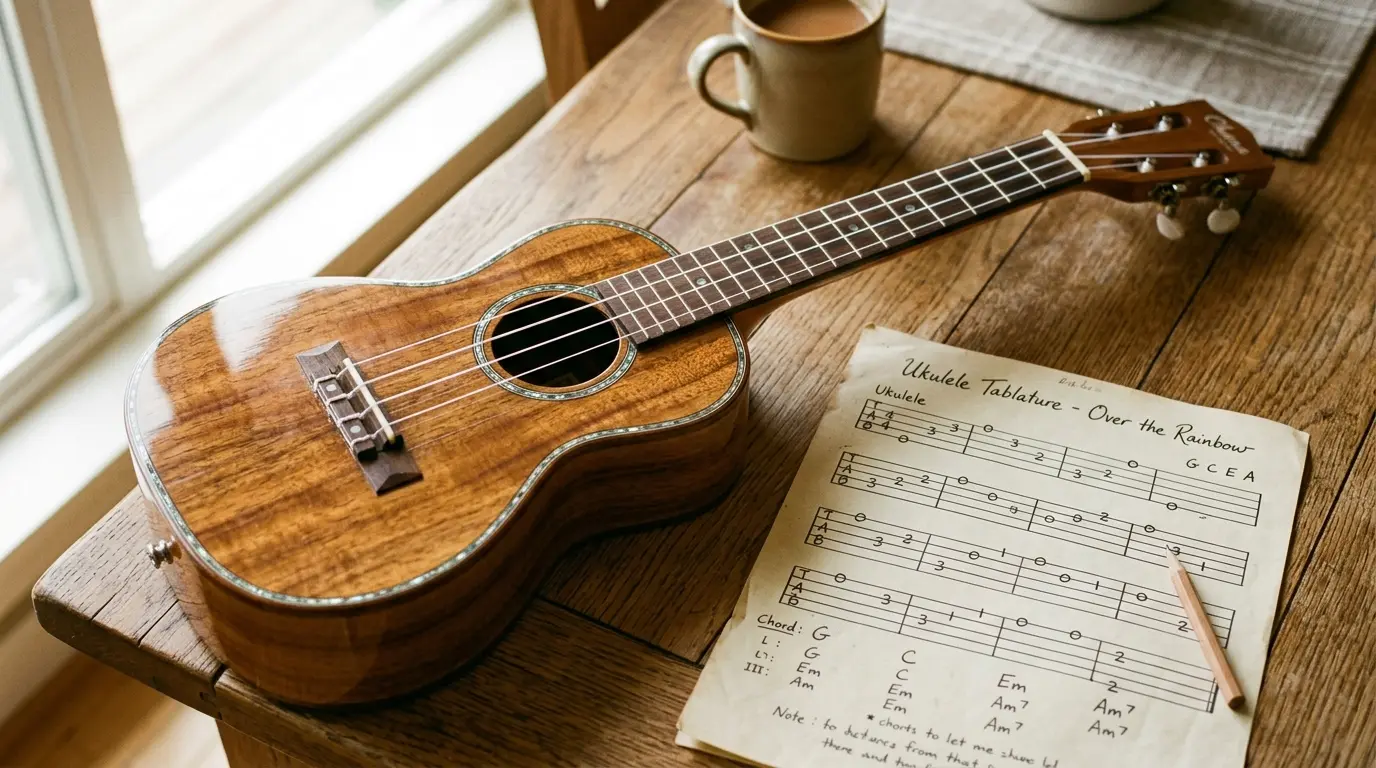
You just bought a ukulele, tuned it up, and looked up the chords for your favorite song. But instead of standard chords, you are staring at a grid of four lines covered in random numbers. It looks like a math equation, and suddenly, playing the ukulele feels incredibly complicated.
Don't panic. What you are looking at is called tablature (or "tabs" for short). Learning how to read ukulele tabs is actually much easier than learning to read standard sheet music. You don't need to memorize note names or key signatures. You just need to know which string to pluck and where to put your fingers.
Most people get confused by tabs the first time because they read the lines upside down. Once you fix that single perspective shift, you will be playing melodies in five minutes.
Here is exactly how to read uke tabs, step by step.
What You'll Need
Before we decode the numbers, make sure you have:
- Your ukulele
- A tuner (use our free Ukulele Tuner to make sure you are in standard G-C-E-A tuning)
- Five minutes of patience
Step 1: Understand the Four Lines
A standard ukulele tab consists of four horizontal lines. These lines represent the four strings on your ukulele.
Here is the trick that confuses almost every beginner: the top line of the tab represents the bottom string of your ukulele.
Imagine holding your ukulele flat on your lap with the strings facing the ceiling, and the neck pointing to your left. If you look down at it, the string closest to your chin is the G string. The string closest to your toes is the A string.
A tab is drawn from that exact perspective:
- Top line: A string (the string closest to the floor when holding it normally)
- Second line: E string
- Third line: C string
- Bottom line: G string (the string closest to your chin)
Step 2: Decode the Numbers
The numbers sitting on the lines do not represent which fingers to use. The numbers tell you which fret to press down.
If you see a "0" on a line, it means you pluck that string "open"—meaning you don't press down on any frets at all. Just pluck the string as it is.
If you see a "3" on the top line (the A string), you place your finger on the 3rd fret of the A string, press down firmly, and pluck.
Tabs are read from left to right, exactly like a book. When numbers are stacked directly on top of each other vertically, it means you pluck all of those strings at the exact same time. This is how chords are written in tab format.

Try This Now
Play your first scale: Look at the simple tab below. Grab your ukulele and play these notes one by one, from left to right.
A |-----------------0---
E |---------0---1-------
C |-0---2---------------
G |---------------------
- Pluck the open C string (0).
- Press the 2nd fret of the C string and pluck (2).
- Pluck the open E string (0).
- Press the 1st fret of the E string and pluck (1).
- Pluck the open A string (0).
If you played that correctly, you just played the first five notes of the C Major scale.
Step 3: Learn the Special Symbols
Numbers and lines will get you through most beginner ukulele songs. But as you look up more complex tabs, you will start seeing letters and symbols mixed in with the numbers. These tell you how to play the note, not just where it is.
- h (Hammer-on): E.g.,
2h4. You pluck the 2nd fret, and while the string is still ringing, you forcefully "hammer" your finger down onto the 4th fret to create a new note without plucking a second time. - p (Pull-off): E.g.,
4p2. The exact opposite. You have both fingers pressed down. You pluck the 4th fret, then pull that finger off the string, allowing the 2nd fret note to ring out. - s or / (Slide): E.g.,
2/5. You press the 2nd fret, pluck the string, and quickly slide your finger up to the 5th fret without lifting it off the wood. - x (Mute): You rest your fingers gently on the string without pressing it down to the fretboard. When you strum, it makes a percussive "thwack" sound instead of a musical note.
Common Mistakes When Reading Uke Tabs
The absolute biggest trap beginners fall into is ignoring rhythm.
Tabs are fantastic for telling you where to put your fingers, but they are terrible at telling you how long to hold the notes. There are no quarter notes or half notes in standard internet tabs. The spacing between the numbers gives you a very rough idea of timing, but it is rarely exact.
If you try to learn a song from a tab without knowing what the song actually sounds like, you will end up playing a robotic, emotionless sequence of notes.
Pro tip: Always listen to the song while you read the tab. Use the tab to find the notes, but use your ears to find the rhythm.
FAQ: Common Questions About Ukulele Tabs
What if my ukulele has a low G string?
Standard ukulele tuning uses a "High G," meaning the top string is actually higher in pitch than the next two strings. Some players prefer a "Low G" to give the instrument a warmer, guitar-like bass. You read the tab exactly the same way regardless of which G string you have. The physical finger placements do not change, though the song will sound slightly deeper.
Do I still need to learn standard chords if I can read tabs?
Yes. Tabs are great for picking out specific melodies or fingerpicking patterns, but if you just want to strum and sing around a campfire, looking up chord charts (using a Chord Finder) is much faster and easier than reading a full tablature grid.
Next Steps: Start Playing
The only way to get faster at reading ukulele tablature is to do it consistently. Don't try to learn a complex fingerstyle arrangement today. Look up the tab for a simple nursery rhyme or a slow pop melody. Play it painfully slow until your brain stops translating the lines upside down.
Related Topics to Explore: