
How to Use a Metronome Effectively
If you've ever searched for how to use a metronome effectively, chances are you've already had a frustrating experience with one.
Maybe you turned it on, set a tempo, started playing, and immediately felt like the metronome was attacking you personally. Every rushed note, every hesitation, every little timing mistake suddenly became impossible to ignore.
I've seen this happen with dozens of students.
The funny thing is that the metronome isn't there to make you feel bad. It's there to show you what's actually happening. The problem is that most musicians approach it in a way that makes practice harder than it needs to be.
Learning how to practice with a metronome isn't about forcing yourself to play along with relentless clicks for an hour. It's about developing a sense of time that eventually feels natural, musical, and reliable.
And that's kind of the whole point.
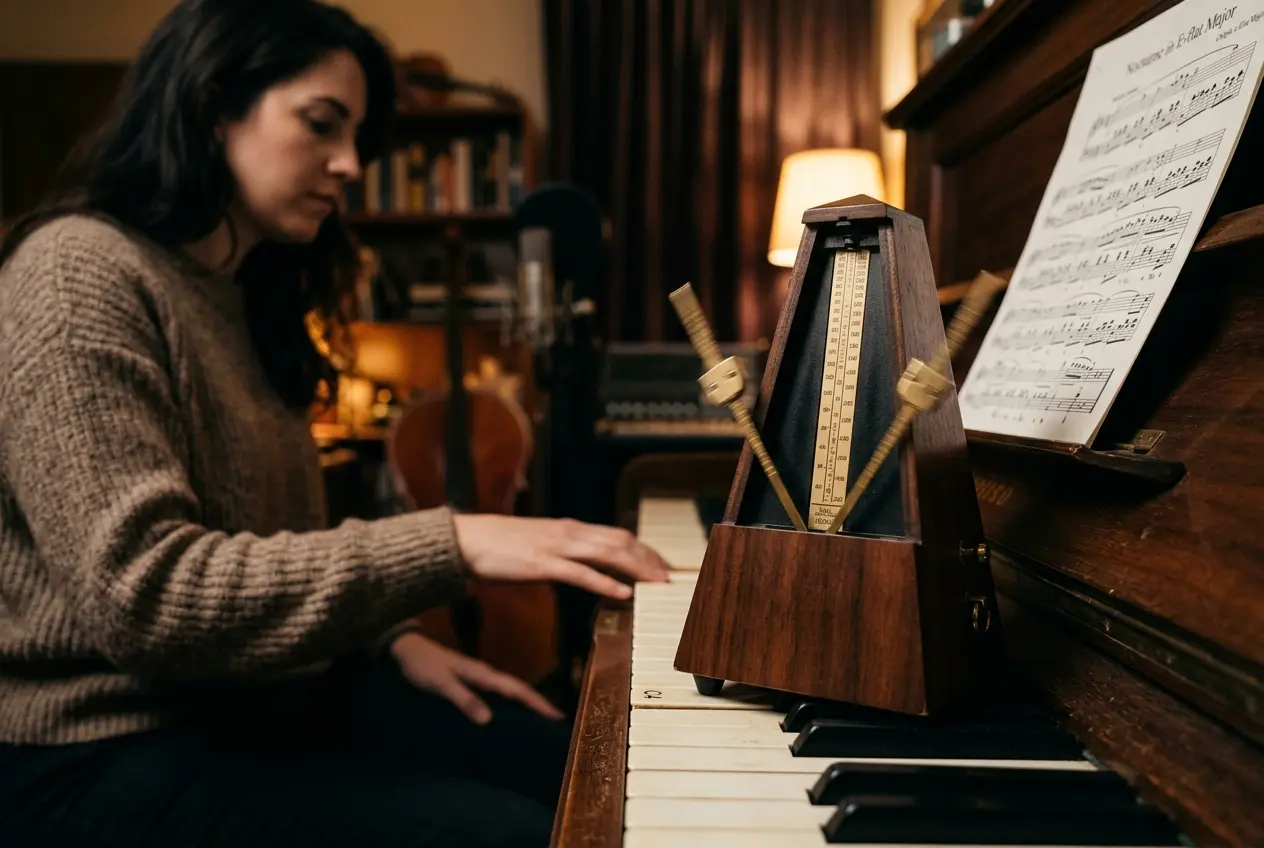
Stop Treating the Metronome Like a Speed Test
One of the biggest beginner mistakes is setting the tempo too fast.
A student learns a new riff, makes a few mistakes at 80 BPM, and immediately decides that practicing at 120 BPM will somehow solve the problem. It won't. Usually it just creates faster mistakes.
My first teacher made me spend nearly a month playing exercises painfully slowly. At the time I hated it. Every session felt like watching paint dry.
Then something interesting happened.
The notes became effortless.
When you practice slowly enough to play accurately, your brain actually has time to learn the movement. When you rush, you're often practicing errors instead of fixing them.
So what does that actually look like?
Start at a tempo where you can play comfortably and consistently. If that feels too easy, that's probably a good sign. Stay there until the rhythm feels stable, then increase the tempo by a few BPM at a time.
The metronome doesn't care how good your excuse is.
If you're rushing, it'll tell you. If you're dragging, it'll tell you that too.
That's valuable information, not criticism.
For anyone looking for practical metronome practice tips, this single habit probably delivers the biggest improvement: slow down enough that you can succeed.
Learn to Listen, Not Chase
Here's another mistake I see all the time.
A musician hears the click and tries to react to it.
The result is that every note arrives slightly late because they're constantly chasing the beat instead of feeling it.
A better approach is to treat the click as a reference point.
Listen to a few measures before you start playing. Let the pulse settle into your body. Tap your foot. Count along. Feel where the beat is before your instrument enters the picture.
Then play with the click instead of after it.
This sounds like a small distinction, but it's huge.
When students finally experience this, there's usually a moment where everything locks together. Suddenly the metronome isn't something external they're fighting against. It's part of the groove.
For a metronome for beginners, I often recommend simple exercises rather than jumping straight into songs. Play scales, basic chord changes, or even a single note on every beat.
That might sound boring, but it teaches one of the most important musical skills: consistency.
And consistency is surprisingly difficult.
Many players can perform a complicated passage once. Fewer can perform a simple passage perfectly ten times in a row.
The metronome helps build that reliability.
Make the Metronome More Musical
At some point, you'll want to move beyond simply following every click.
This is where metronome practice gets really interesting.
Try setting the metronome to click only on beats 2 and 4. Or set it to half the speed so each click represents an entire measure. Suddenly you're responsible for maintaining more of the rhythm yourself.
At first it feels terrifying.
Then it starts strengthening your internal clock in a way that constant clicking never could.
Another useful exercise is to let the metronome play for a few measures, then mute it for a few measures if your app supports that feature. When the click returns, you'll quickly discover whether your timing stayed steady.
Sometimes students are shocked by the results.
They thought they were perfectly in time. The metronome returns and reveals they've drifted halfway to another planet.
That's normal.
Timing is a skill, and skills improve through repetition.
The goal isn't to become dependent on the metronome forever. The goal is to develop such a strong sense of pulse that you can maintain good timing even when the click disappears.
That's why learning how to use a metronome effectively is about much more than following a beat. It's about training your ears, your attention, and your musical instincts.
So if you've been avoiding the metronome, don't worry. Almost every musician goes through that phase.
Start slower than you think you need to. Listen more than you react. Be patient with the process.
A few minutes of focused practice each day will do far more than forcing yourself through an hour of frustrated clicking.
Eventually you'll notice something surprising.
The metronome stops feeling like an enemy.
It starts feeling like a really honest practice partner.
Practice Now
Ready to put these tips into action? Try our Online Metronome. It features precise timing, volume control, and a visual beat indicator to help you master your internal clock.