
How to Transpose a Song: A Simple Step-by-Step Guide
If you've ever tried to sing along to your favorite track and felt like your throat was going to snap on the high notes, you've encountered a classic musical problem. The song isn't too hard to sing; it's just in the wrong key for your specific vocal cords. To fix this, you need to learn how to transpose a song. Transposing simply means taking a piece of music and shifting all of its notes or chords up or down by the exact same distance.
Once you know how this works, you'll never have to strain your voice again. You can quickly adapt any piece of sheet music or chord chart to match where you sound best.
Why Do You Need to Change the Key of a Song?
The most common reason people change the key of a song is to accommodate a singer. Everyone has a unique vocal break and a comfortable singing range. If a pop star with a naturally high tenor voice wrote a hit song, a bass or baritone singer will likely struggle to perform it in the original key.
But singers aren't the only ones who benefit. Instrument players often transpose music to make it physically easier to play. For example, a song written in D-flat major (which has five flats) might be incredibly awkward for a beginner guitarist to strum. Transposing the chords for guitar into C major or G major removes those difficult barre chords entirely.
How to Transpose a Song Manually Using Numbers
The hardest way to transpose is to try and memorize exactly which chord follows which across all 12 keys. The easiest way to do it is to stop thinking in letters (A, B, C) and start thinking in numbers (1, 2, 3). This is deeply rooted in traditional music theory (often called Roman Numeral Analysis), but you don't need a degree to use it.
Every major scale has seven notes. If we assign a number to each note, we can map out a song based on its numbers rather than its specific chords.
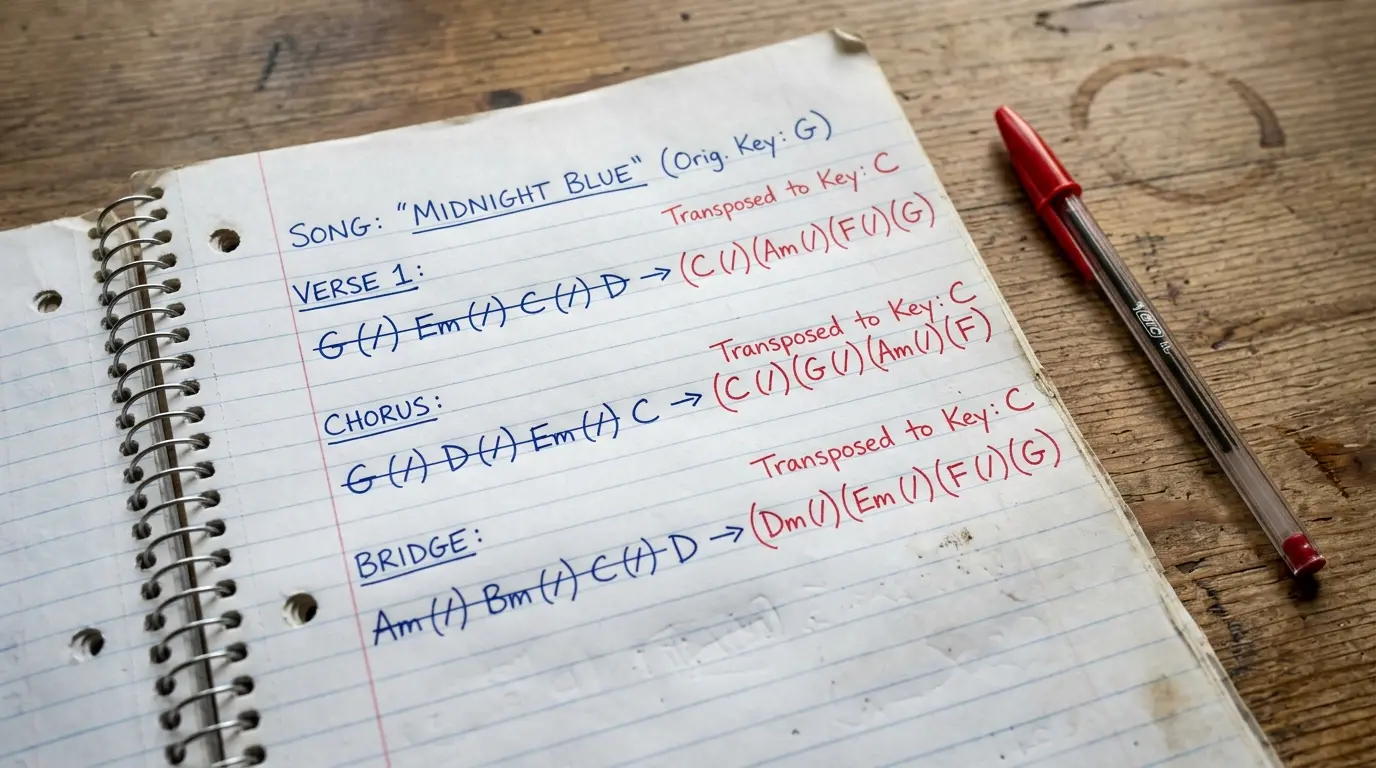
Try This Now: The Number System
Let's say you are playing a song in the key of C Major. The chords are C – F – G.
- Count up the C major scale (C, D, E, F, G, A, B).
- Assign numbers: C is 1, F is 4, and G is 5.
- Your chord progression is simply a 1 – 4 – 5.
Now, let's transpose that song to the key of G Major to find the right key for your voice.
- Write out the G major scale (G, A, B, C, D, E, F#).
- Find the 1, 4, and 5 chords in this new scale.
- The 1 is G. The 4 is C. The 5 is D.
- Your new transposed chords are G – C – D.
You've successfully transposed the song without doing any complicated guesswork!
Transposing Chords for Guitar Using a Capo
If you play guitar, you have a physical cheat code available to you: the capo. A capo acts as a movable "nut" that clamps down across the fretboard, effectively raising the pitch of all the strings at once.
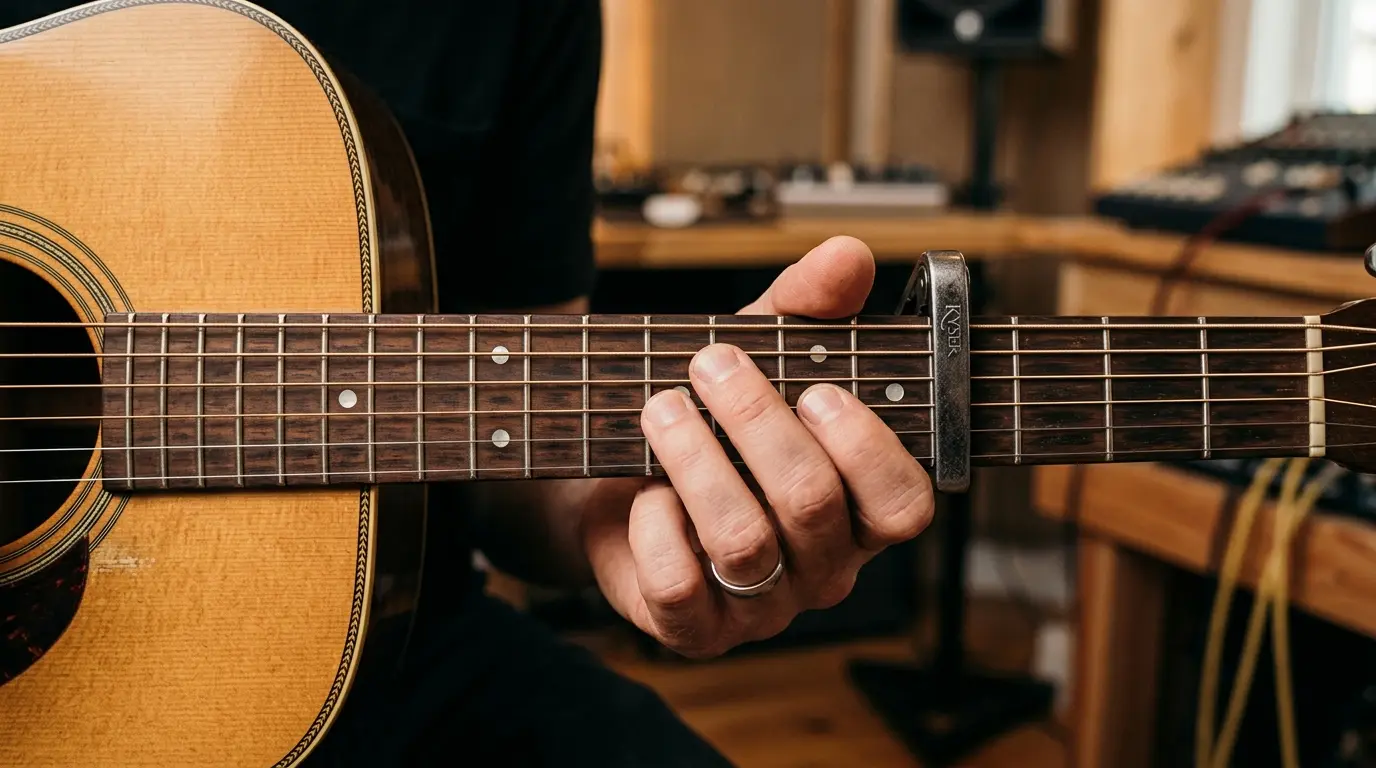
Pro tip: If you place a capo on the 2nd fret and play a standard C major chord shape, the actual sound coming out of the guitar is a D major chord.
To use a capo properly, you just need to count frets. Every fret on a guitar represents one half-step. If a song is originally in the key of G, but you want to sing it slightly higher in the key of A, you just need to move up two half-steps. Place the capo on the 2nd fret, play your normal G chords, and the guitar will do the mathematical transposing for you.
Common Mistakes When You Transpose Music
When beginners first start shifting keys around, they often fall into a few traps. Here is what to watch out for:
- Forgetting minor chords: If the original song has an A minor chord as the 6th chord, the transposed version must also use a minor chord in that 6th slot. The quality (major or minor) of the chord never changes during transposition.
- Going too far in one direction: If you transpose a song up a perfect fifth, it might suddenly become too high for the singer. Sometimes, it's better to transpose down a fourth instead to achieve the same relative key change while keeping the melody in a comfortable, lower register.
- Relying entirely on digital tools: While there are apps that will transpose music for you instantly, relying on them means you never learn the relationship between the chords. Doing it manually a few times builds a massive amount of musical intuition.
Frequently Asked Questions
Does transposing change the melody?
No. Transposing moves every single note up or down by the exact same distance. The spaces between the notes remain identical. As a result, the melody sounds exactly the same to the human ear; it is just sitting at a higher or lower overall pitch.
How do I know which key to transpose to?
This requires a little bit of trial and error. You need to know the highest and lowest notes of the melody you are trying to sing. Compare those notes to your comfortable singing limits. If you aren't sure what your limits are, read our guide on finding your vocal range.
Your Next Steps
Stop forcing your voice to hit notes that hurt. Pick a song you currently struggle to sing. First, write down the original chords. Next, figure out what number each chord represents in the original key. Finally, pick a new key that is slightly lower or higher, and rewrite the progression using those same numbers.
Grab your instrument and play the new chords. You'll be amazed at how much easier the song feels when it's tailored directly to you.