
Song Structure Explained: Verse, Chorus, Bridge & More
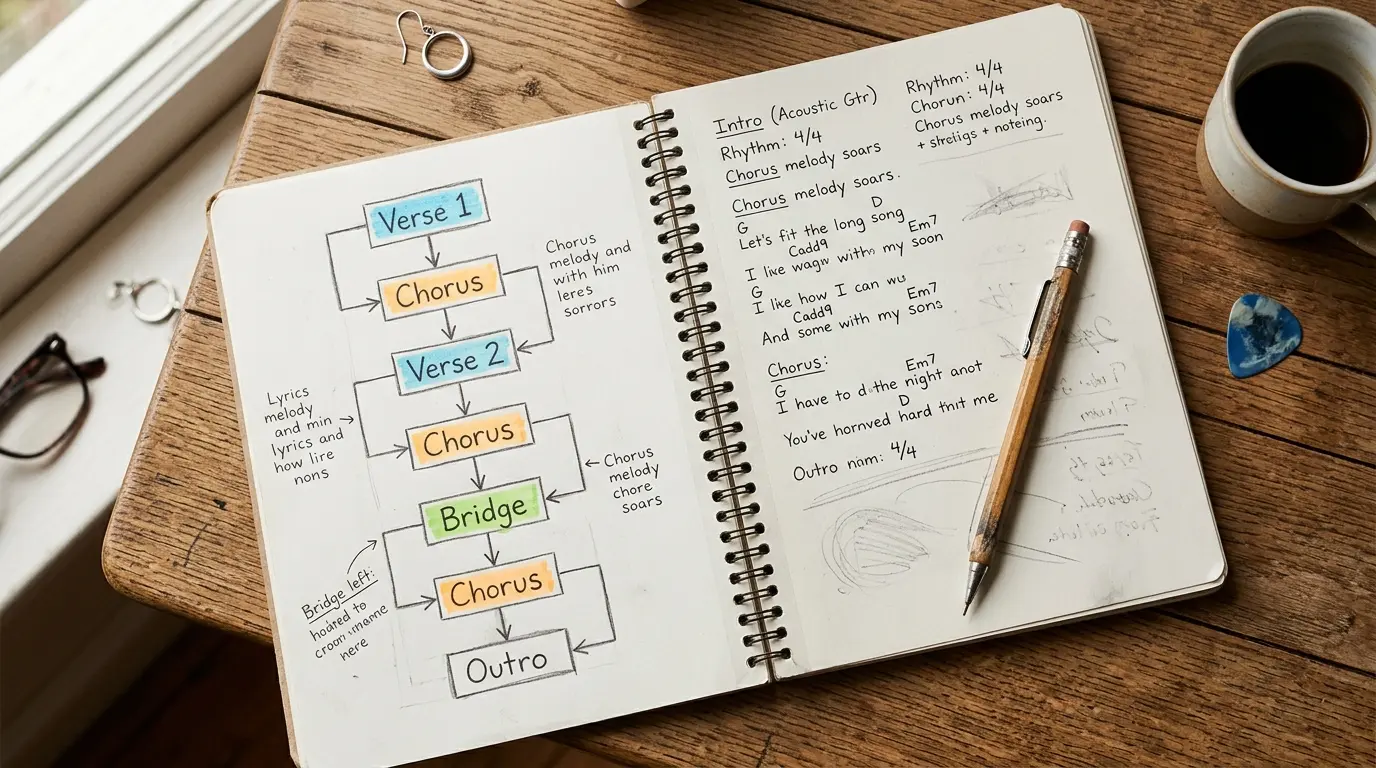
You've written a great chorus. The melody sticks, the words hit, and you can already hear it in your head. But the verse before it feels flat, you're not sure if you need a bridge, and the whole thing falls apart after the second chorus. That's not a songwriting problem — that's a structure problem.
Understanding song structure — how the verse, chorus, bridge, and other sections fit together — is what separates a collection of musical ideas from an actual finished song. Once you see how these building blocks work, arranging your music stops feeling like guesswork.
What Is Song Structure and Why Does It Matter?
Song structure is the order in which different sections of a song appear. Think of it as the blueprint of a house. You can design the rooms however you want, but without a floor plan, you'll end up with doors that open into walls.
Every section of a song has a specific job. The verse tells the story. The chorus delivers the emotional punch. The bridge offers a change of scenery right when the listener needs it. When those sections are arranged well, the song feels inevitable — like it couldn't have been built any other way.
Structure also helps your listener. People's ears unconsciously expect certain patterns. When a verse drops the energy slightly, they lean in, waiting for the chorus to lift it back up. When a bridge shifts the harmony, it creates tension that makes the final chorus land harder. You're not being formulaic — you're using the listener's expectations as a tool.
How the Verse Works in a Song
The verse is where your song lives. It carries the narrative, sets the scene, and gives the listener specific details — who, what, where, when, why. If the chorus is the thesis statement, each verse is a supporting paragraph.
Most songs have two or three verses, and each one should move the story or emotion forward. Verse 1 sets up the situation. Verse 2 develops it — adds a complication, a new perspective, or a deeper layer of feeling. If there's a third verse, it often resolves or reframes everything that came before.
Musically, verses tend to sit in a lower dynamic range than the chorus. The melody might stay in a narrower pitch range, the instrumentation might be sparser, and the rhythm might feel more conversational. This contrast is deliberate. If the verse hits just as hard as the chorus, neither one stands out.
Pro tip: If your verse melody and chorus melody feel too similar, try starting them on different notes. If your chorus begins on the root note (say, C in the key of C major), try starting the verse on the 5th (G) or the 3rd (E). That small change creates an immediate sense of motion when the chorus arrives.
A common mistake is stuffing verses with too many words. Verses need room to breathe. If your listener can't absorb the lyrics at normal speed, you've overcrowded the section. Read your verse out loud at tempo. If you're gasping for air, edit it down.
What Makes a Great Chorus?
The chorus is the emotional center of your song. It's the section people sing along to, the part that sticks in their memory after the song ends. Structurally, the chorus repeats — usually two or three times — with the same (or nearly the same) lyrics and melody each time.
That repetition is the whole point. The chorus earns its power through familiarity. By the second time it appears, the listener already knows the melody. By the third, they're singing it. This is why chorus melodies tend to be simpler and more singable than verse melodies. You want the hook to land immediately, not after three careful listens.
A strong chorus usually does three things:
- Lifts the energy. The melody moves to a higher register, the dynamics swell, or more instruments come in. The listener should feel the chorus arrive physically — a shift in intensity.
- Delivers a clear, repeatable idea. The best choruses can be summed up in a single phrase. "I Will Always Love You." "Smells Like Teen Spirit." "Rolling in the Deep." That central phrase is your hook.
- Resolves the harmonic tension set up by the verse. If your verse ends on a chord that feels unfinished (like a V chord or a vi chord), the chorus should land on something stable — often the I chord. That resolution is what makes the transition feel satisfying.
If your chorus doesn't feel different enough from your verse, check three things: the melodic range (chorus should be higher or wider), the rhythmic density (chorus often has longer, more sustained notes), and the chord voicings (fuller, more open chords in the chorus).

How a Bridge Changes Everything
The bridge is the section that appears only once, usually after the second chorus. Its job is contrast. By the time the listener has heard two verse-chorus cycles, the pattern is established — and if you just repeat it again, the song starts to feel predictable. The bridge breaks that pattern.
Musically, the bridge typically changes at least one major element: the chord progression, the melody, the rhythm, or the perspective of the lyrics. Many bridges shift to a relative key — if your song is in C major, the bridge might drift toward A minor or F major. That harmonic shift creates a feeling of being somewhere new without sounding disconnected from the rest of the song.
Lyrically, the bridge often offers a new angle on the song's theme. If the verses describe a problem and the chorus expresses an emotion about it, the bridge might step back and offer reflection, a turning point, or a revelation. Think of it as the "but" or "meanwhile" in the song's story.
Not every song needs a bridge. Plenty of hits use a verse-chorus-verse-chorus-chorus structure and it works perfectly. But when a song does have a bridge, it typically makes the final chorus land with more force — because the listener has been somewhere unexpected and now returns to familiar ground with fresh ears.
What Are the Most Common Song Structures?
Here are the structures you'll hear in the vast majority of popular music. Learning to recognize them trains your ear and gives you reliable starting points for your own writing.
Verse-Chorus (ABAB): The simplest repeating form. Verse, chorus, verse, chorus. Common in punk, folk, and shorter pop songs. It works when your verses are strong enough to carry the song without a bridge. Think of many Ramones songs or simple folk ballads.
Verse-Chorus-Bridge (ABABCB): The most common pop and rock structure. Two verse-chorus cycles, then a bridge that leads into a final chorus. This is the structure behind an enormous number of hit songs — from "Someone Like You" by Adele to "Let It Be" by The Beatles. The bridge gives the song a sense of arc and development.
Verse-Pre-Chorus-Chorus (AB'BAB'B): Adding a pre-chorus (a short transitional section between the verse and chorus) builds anticipation. The pre-chorus typically rises in energy or harmonic tension, making the chorus feel even more like an arrival. Listen to "Don't Stop Believin'" by Journey — the "strangers waiting" section is a textbook pre-chorus.
AABA (32-bar form): An older structure common in jazz standards and classic pop. Two A sections (similar to verses with a built-in hook), a B section (the bridge), and a return to the A section. "Somewhere Over the Rainbow" follows this form. It's less common in modern pop but still shows up in ballads and singer-songwriter material.
Through-composed: No repeated sections at all. Each part of the song is unique. This is rare in popular music but common in art song, progressive rock, and some hip-hop tracks. It's the hardest structure to pull off because the listener has no familiar ground to return to.
Which Song Structure Should You Use?
If you're writing your first songs, start with verse-chorus-bridge (ABABCB). It gives you the most room to develop ideas while still providing a reliable framework. Once you're comfortable writing within that structure, experiment with dropping sections, extending the bridge, or adding a pre-chorus.
The structure should serve the song, not the other way around. If your song feels complete after two verse-chorus cycles and doesn't need a bridge, don't force one in. If your chorus is so strong that it can carry extra repeats at the end, let it. Structure is a guide, not a cage.
How to Map Out Your Song Before You Write
Before you start recording or even writing full lyrics, sketch your structure on paper. This one habit will save you from the most common songwriting frustration: getting halfway through a song and not knowing where to go next.
Here's a simple process:
- Decide on your core structure. Write out the section labels in order: Intro – V1 – Ch – V2 – Ch – Bridge – Ch – Outro. Adjust as needed.
- Assign a rough emotional arc to each section. For example: V1 (curious, setting the scene) → Ch (confident, main statement) → V2 (deeper, more vulnerable) → Ch (confident again) → Bridge (doubt, tension) → Ch (triumphant resolution).
- Choose your key and a basic chord progression for each section. Even just knowing "the verse uses Am–F–C–G and the chorus uses F–G–Am–C" gives you a foundation.
- Set a rough bar count. Most pop verses are 8 or 16 bars. Choruses are often 8 bars. Bridges are typically 4 to 8 bars. These aren't rules — they're starting points.
- Write to the map. Fill in melody and lyrics section by section, checking that each part does its job (verse = story, chorus = hook, bridge = contrast).
This doesn't lock you in. You'll adjust things as you go. But having a map means you always know what the next section needs to accomplish, even when inspiration stalls.
Try This Now
Pick a song you love — one you've heard dozens of times. Listen to it once more with a pen and paper. Write down each section as it happens: verse, chorus, pre-chorus, bridge, intro, outro. Note how many bars each section lasts and where the energy peaks. You'll start hearing the architecture underneath the music, and that awareness will immediately improve your own songwriting.
Frequently Asked Questions About Song Structure
What's the Difference Between a Pre-Chorus and a Bridge?
A pre-chorus appears before the chorus, usually in every verse-chorus cycle. It's a short buildup — often just 2 to 4 bars — that creates momentum leading into the chorus. A bridge appears only once, typically after the second chorus, and its job is to break the pattern entirely. Pre-chorus builds anticipation; bridge provides contrast.
Can a Song Have Two Bridges?
Technically, yes, but it's very uncommon in popular music. If a section repeats, it stops functioning as a bridge — because the bridge's purpose is to be the one section that sounds different from everything else. If you find yourself wanting two bridges, you might actually be writing a through-composed song or need to reconsider whether one of those sections is really a different verse.
Do I Have to Follow a Standard Song Structure?
No. Structure exists to help you communicate with your listener, not to limit your creativity. Many groundbreaking songs break structural conventions intentionally. But — and this matters — those songwriters understood the conventions before they broke them. Learn the standard forms first. Once you can write a solid ABABCB song, you'll know exactly which rules to bend and which to keep.
The next time you sit down to write, don't start with the lyrics or the chords. Start with the map. Write out your section labels, assign each one a job, and then fill them in. You'll find that half the struggle of finishing a song disappears when you know where you're going. If you want to strengthen your lyric writing once the structure is in place, check out our step-by-step guide to writing lyrics. And if you're still building your theory foundation, our guide to music scales will help you choose chords and melodies that fit together naturally.